No products in the cart.


The cleanliness and janitorial sector in Canada has had a structural labour shortage for years with sector unemployment consistently running below the national average since 2022. Nonetheless cleanliness expectations are on the rise and operational budgets are not keeping pace. Maintenance managers have increasing standards to meet, but fewer resources to meet them
With robotic cleaning technology, facility managers now have a way to close that gap. AI-powered autonomous systems can operate in large areas without needing dedicated operator oversight. They provide a consistent cleaning outcome while alleviating pressure on existing crews.
Commercial cleaning robots are being adopted rapidly in various sectors. To meet the rising demands and shrinking availability of labour, warehouses, hospitals, factories, schools, and commercial buildings are rolling out robotic cleaning technology. We expand upon what this technology does, where it is being used, and why facility managers from across Canada increasingly consider robotic cleaning a mainstay operational investment, in this blog.
The Growing Challenges of Commercial Facility Management
Facility managers today are navigating a set of compounding pressures that manual cleaning operations were not designed to handle:
- Across Canada, cleaning and maintenance positions are experiencing labour shortages. The market requires significant manpower. There are issues with labour shortages and wage inflation thus creating problems in staffing and retaining dependable cleaning teams.
- Metal structures are gaining in popularity, especially in the crane and construction sectors. Industry insiders were skeptical about the strong demand, but makers of crane and construction metal structures are investing substantial capital for future expansion.
- The rise of hygiene and cleanliness expectations has accelerated in places like healthcare and food-adjacent environments because surface contamination carries real compliance and liability risks.
- Due to the increasing pressure of both labour and operational costs, justifying manual-only cleaning programs with overtime, night shifts, and supervision overheads is growing harder.
- Although you have the appropriate number of people hired, scheduling unpredictability may provide gaps in coverage that affect safety, audit readiness, and operational performance on a daily basis.
These pressures are pushing facility managers toward efficient, scalable alternatives, and robotic cleaning technology is increasingly the answer.
What Is an Autonomous Cleaning Robot?
An autonomous cleaning robot is a self-navigating machine designed to clean floors across wide indoor spaces without continuous input from a human operator. These systems use onboard intelligence to map out controlled cleaning routes, detect obstacles and carry out cleaning processes according to a programmed schedule.
The core technology behind these machines includes:
- An AI navigation system capable of mapping environments in real-time and creating optimized cleaning paths based on facility layout and traffic.
- Sensors and obstacle avoidance technology that detect people, equipment, and structural features that help the robot avoid obstacles and change course without stopping or disrupting ongoing operations.
- A facility map is created by proposing an autonomous route using SLAM technology which also builds an accurate map of the facility without requiring any markers of QR codes.
- Multi-function automated cleaning systems, that sweep, scrub, vacuum and mop in one operation pass.
- The need for human intervention is minimal, with most units completing full cleaning cycles before returning to the dock, recharging and then resuming tasks without staff.
How Autonomous Industrial Cleaning Robots Work
An autonomous industrial cleaning robot will function as a managed site asset in a commercial or industrial facility. Generally, the operation process consists of following stages.
- Mapping and navigation: When first deployed, the robot scans the site with visual and laser SLAM to produce a detailed floor map. This map provides the foundation for future cleaning routes, which are modified according to the environmental changes.
- Intelligent path optimization: The robot works out the best route within the facility, subject to its layout, obstacles and busy areas. As conditions change at the facility, routes can be adjusted remotely.
- Real-time monitoring and reporting: By using a connected app or dashboard, facility managers can monitor the cleaning progress, area covered and performance metrics. Clients gain full visibility over what has been cleaned, when it was done, and to what standard.
- Automated charging and task scheduling: If the battery power drops during a cycle, the robot goes back to the docking station and resumes from where it left off after recharging. Cleaning schedules can be programmed for the future, without any manual intervention.
- Data collection for facility managers: Industrial cleaning automation platforms generate efficiency reports, mapping logs, and upkeep notifications. Compliance documentation, staff scheduling and operational planning at a single or multi-site facility.
Applications of Cleaning Robots Across Commercial Facilities
Warehouses and Distribution Centers: Maintaining a large warehouse floor is one of the toughest jobs in any industry. Bigger spaces are more important in cleanup of dust, debris, and spills. Automation designs can facilitate the maintenance of a clean floor throughout off-peaking hours or overnight shifts without deploying staff to perform ongoing sweeping and scrubbing programs.
Manufacturing Facilities: Industrial floors can collect dirt, cooling oils, and dust so finely that it may not always be possible to safely and reliably clean it by hand. Robots for industrial cleaning environments are designed to cope with these conditions for long hours to control contamination, safety and hygiene standard compliance of the facility.
Healthcare Facilities, Hospitals, and clinical facilities Few sectors require a greater degree of cleaning frequency and documentation than these. Since it maintains a cleaning schedule and creates logs, which serve as proof of cleaning activities for audits and inspections, it helps ensure hygiene compliance in these environments.
Retail and Shopping Centers. Areas in retail environments with high foot traffic require attention on an ongoing basis throughout opening hours and not just in the overnight maintenance period. Cleaning robots work around shoppers and staff to present standards without interfering with the customer experience or requiring operators dedicated supervision.
Educational Institutions, Schools and universities manage large facilities with variable occupancy patterns and often limited custodial staff. Robotic cleaning systems allow these institutions to maintain consistent standards across hallways, gymnasiums, and common areas regardless of budget constraints or staffing availability.
Featured Solution: PUDU CC1 Pro AI-Powered 4-in-1 Autonomous Floor Cleaning Robot
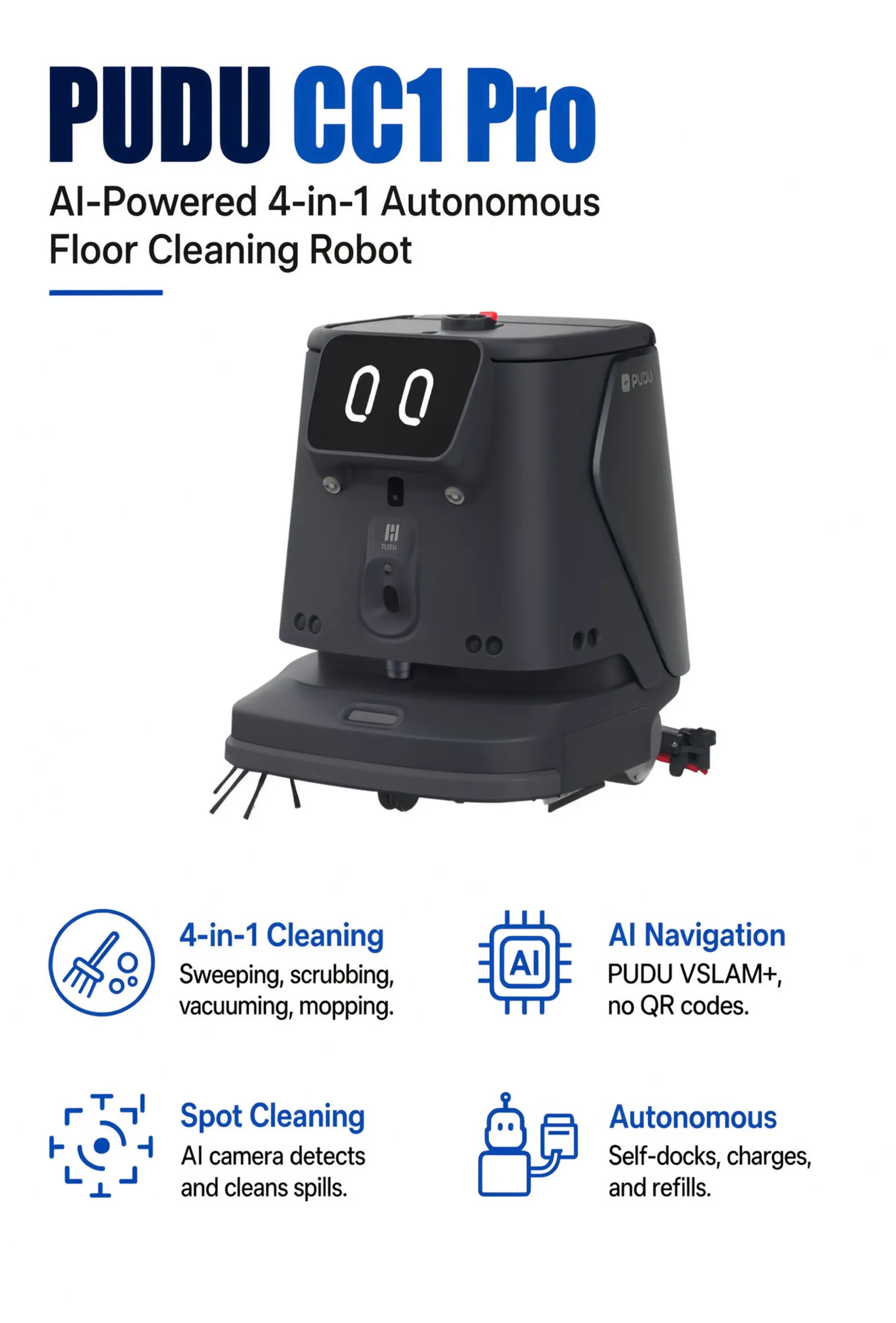
Available through Robotools Canada, the PUDU CC1 Pro is a purpose-built autonomous cleaning robot designed for large commercial and industrial facilities. It consolidates four cleaning functions into a single machine, reducing equipment overhead and simplifying facility maintenance programs for operators managing high-demand environments.
4-in-1 Cleaning Functions: The CC1 Pro handles sweeping, scrubbing, carpet vacuuming, and dust mopping in a single unit. This multi-mode capability means facilities do not need separate machines for different floor conditions. The robot automatically detects floor type and switches between modes accordingly, activating sweep-and-vacuum on hard floors and switching to vacuum-only on carpets.
AI-Powered Navigation: The CC1 Pro uses PUDU VSLAM+ technology, a fusion of visual SLAM and LiDAR, to map and navigate complex environments accurately without relying on QR codes or physical markers. It generates optimized cleaning routes, avoids dynamic obstacles in real time, and adjusts its path as the environment changes. Coverage area reaches 5,000 to 8,000 square metres per deployment, making it well-suited for airports, shopping malls, hospitals, and large commercial buildings.
Intelligent Spot Cleaning: A rear-facing AI camera monitors floor cleanliness in real time during each cleaning pass. When the system detects a wet stain, spill, or soiled area, it automatically triggers a targeted cleaning response and increases scrubbing intensity as needed, achieving a cleaning rate of 1,500 to 3,000 square metres per hour in spot scrubbing mode. After each task, the system generates a heatmap showing cleaning coverage and flagged areas, giving facility managers a clear, documented record of performance.
Autonomous Operation and Data Reporting: The CC1 Pro manages its own scheduling, docking, charging, and water usage without needing staff involvement. When the battery is low, it goes back to its docking station dock. Refills water, drains dirty water, then continues cleaning from the point it left off By using the PUDU Link management platform, cleaning work is scheduled, and performance is followed through the operation dashboard to visualize the level of task completion and maintenance frequency and alerts on the equipment in real time.
Key Benefits of Using Autonomous Cleaning Robots
- Improved Cleaning Consistency: The efficiency in delivering manual cleaning programs depends on the consistency of the staff. Cleaning quality is affected by shift changes, absenteeism and differences in work approaches, and it is difficult to manage. Robotic systems take the same route, at the same time, to the same standard every cycle, and thus remove that variability.
- Increased Operational Efficiency: Robotic systems apply cleaning standards on a fixed schedule. Thus, they don’t have the variability of manual cleaning programs. Cleaning quality for facilities remains the same every cycle, irrespective of staff levels or shift changes.
- Reduced Labour Pressures: When routine floor-cleaning tasks are taken over by autonomous systems, facility teams get more freed up to do work which needs direct human touch. Covers high-touch surfaces, detailed sanitation and specialty cleaning tasks with increasing consistency, while reducing disruption to the overall cleaning program due to staffing gaps and workforce fluctuations.
- Enhanced Facility Safety: Slip-and-fall accidents are one of the most common types of injury claims in manufacturing and industrial workplaces. Floor condition contributes directly to this class of claim. The automated cleaning systems clean floors on a set schedule instead of in response to soil aging. This reduces the risk across the facility without relying on the staff to request a cleaning action.
- Data-Driven Facility Management: Keeping track of performance analytics and cleaning gives the facility managers a deem of cleaning activity. It asks for the multilingual site maintenance planning compliance reporting good quality assurance.
- Better Resource Allocation: When floor cleaning is done automatically, employees have more time to spend on high-touch, more meticulous and manual cleaning surfaces that can use it. Enhance productivity without adding headcount.
Why Facility Managers Are Investing in Cleaner Robots
Facility operators now clearly see the business case for commercial cleaning robots. Firms in all sectors are investing in automation because of cost reduction and operational performance enhance.
Cleaner robot solutions on predictable cleaning schedule eliminate variability in manual programs. By minimizing overtime costs and the need to supervise employees, these systems generate performance data that enhance accountability for operations. As time goes on, the ROI strengthens as the technology takes on more routine maintenance and frees up facility budgets for more important operational spending.
Robotic cleaning systems are highly scalable for multi-site organisations. A deployment model that works at one site can be replicated across a portfolio with uniform outcomes which is quite difficult with manual teams working at different locations and within different schedules.
Supporting Cleaning Teams Through Automation
One of the most essential business realities of implementing robotic cleaning systems is they work together with staff rather than replacing them.
Autonomous cleaning handles the repetitive, large-area floor maintenance that consumes the most time in any cleaning program. This frees staff to focus on:
- High-touch surfaces: Door knobs, counters, equipment control levers, and other human contact surfaces that need to be disinfected properly with suitable products.
- Detailed sanitation: restrooms, kitchens, and clinical areas where thoroughness and judgement matter and where consistent human oversight is required.
- Specialized cleaning tasks: post-construction cleanup, deep-cleaning cycles, and event preparation that fall outside routine maintenance schedules.
This division of labour improves both employee productivity and job satisfaction by reducing the physically demanding, repetitive aspects of cleaning work.
Choosing the Right Autonomous Cleaning Robot for Your Facility
Not all robotic cleaning solutions can clean every environment. Facility managers should verify the below factors in the selection of a system.
- Facility size: A scrubber with a size to suit the actual footprint of larger facility. Before you make a model selection, check the rated coverage area against your floor plan. Make sure it has enough run time, water tank capacity, and cleaning path width to tackle the space without interruptions.
- Cleaning requirements: Begin by determining your floors’ actual requirements. If your facility deals with wet spills, tracked-in debris, and various floor surfaces, a multi-mode unit that sweeps, scrubs, vacuums and mops will cover more ground. A basic-use appliance may be sufficient if the cleaning requirement is basic.
- Navigation technology: Effective navigation tools are optimized in busy facilities. SLAM-based systems build and update their own maps in real-time, allowing the robots to work accurately in locations where the layout changes, the equipment is never fixed, and people move around. Systems that rely on older markers require fixed reference points. They do not cope well when things change.
- Battery performance: The ability to resume from breakpoints is essential for major systems. The robot should return to dock and recharge and complete its assigned area without a manual reset being required.
- Reporting capabilities: Seek interconnected systems that facilitate remote monitoring, scheduling, and post-task reporting through a management platform.
- Maintenance and support: Ensure that you will be getting consumables, parts, and technical support in Canada to avoid long downtime.
- Scalability: See if the system supports centralized scheduling and fleet management across locations for multiple location owners.
The Future of Commercial Facility Management with Autonomous Cleaning Technology
Industrial cleaning automation is moving quickly. AI-powered scheduling, smarter route optimization, and tighter integration with facility management platforms are already available in current-generation systems, and the trajectory points toward even broader capability.
Automated cleaning systems are increasingly being connected to building management infrastructure, enabling facility managers to coordinate cleaning schedules with occupancy data, IoT sensors, maintenance workflows, and compliance reporting through a single integrated platform. This shift from standalone cleaning equipment to connected facility intelligence is the defining trend of the next phase of commercial cleaning adoption across Canada and internationally.
As robotic cleaning technology becomes more accessible through purchase, lease, and rental models, the question for most facility managers is no longer whether to adopt it, but how quickly to scale it across their operations.
Conclusion
Autonomous cleaning technology is an operational tool that is actively transforming how commercial and industrial facilities are managed across Canada.
An autonomous cleaning robot delivers consistent, data-backed floor maintenance that scales with facility size and operates independently of workforce availability. For large-scale environments facing labour shortages and rising operational demands, an autonomous industrial cleaning robot addresses the core challenge: maintaining high cleanliness standards without proportionally increasing headcount or cost.
Modern cleaning robots and cleaner robot solutions give facility managers the control, visibility, and reliability that manual programs cannot consistently provide. The PUDU CC1 Pro AI-Powered 4-in-1 Autonomous Floor Cleaning Robot, available through Robotools Canada, represents that standard, combining AI navigation, intelligent spot cleaning, world-first rear camera performance detection, and fully autonomous operation in a single platform built for demanding commercial environments.
If your facility is ready to move beyond reactive cleaning programs, explore the robotic cleaning solutions available through Robotools Canada and find the right fit for your operation.
Frequently Asked Questions
How does an autonomous industrial cleaning robot work?
An autonomous industrial cleaning robot maps the facility using SLAM navigation technology, generates an optimized cleaning route, and executes the cleaning program on a defined schedule. It monitors its own battery and water levels, docks automatically when needed, and resumes tasks after recharging without manual intervention.
What facilities can benefit from cleaning robots?
Cleaning robots are well-suited to warehouses, distribution centres, manufacturing plants, hospitals, retail spaces, shopping centres, airports, hotels, and educational institutions, in any environment with large floor areas, high cleanliness standards, or labour constraints.
What are the advantages of using a cleaner robot?
A cleaner robot improves cleaning consistency, reduces labour pressures, lowers operational costs, enhances floor safety, and generates performance data that supports compliance and facility management decisions. It also allows human staff to focus on higher-value cleaning tasks.
How does the PUDU CC1 Pro improve commercial cleaning operations?
The PUDU CC1 Pro combines four cleaning functions in one machine, uses PUDU VSLAM+ navigation for accurate route planning without QR codes, detects and responds to high-dirt areas in real time through its rear AI camera, and operates fully autonomously, including docking, charging, and water management. It provides remote monitoring and post-task heatmaps through the PUDU Link management platform.
Can autonomous cleaning robots help address labour shortages?
Yes. Autonomous cleaning robots handle large-area floor maintenance on a programmed schedule without requiring dedicated staff. This reduces dependence on manual labour for routine cleaning tasks and allows existing team members to focus on specialized or high-touch cleaning that requires human involvement.