No products in the cart.


There is a generational workplace shift that is happening in Canada. The proportion of older workers in the UK labour force is historically high, with a notable twelfth of workers now aged 65 or over. With the speed of retirements increasing, the industries that rely on physical labour both have a structural gap that wage increases and deep recruiting drives cannot fix.
Manufacturing, warehousing, logistics, and facility management are feeling this most directly. These sectors depend on roles that are difficult to automate through policy or incentive, and equally difficult to keep filled through conventional hiring. The math does not work in their favour.
Robotics changes the equation. Rather than competing for an increasingly limited pool of workers for roles that are repetitive and physically demanding, businesses are deploying robotic systems to cover those functions reliably. Robotics companies across Canada are helping businesses make that shift in a way that supports existing teams rather than replacing them.
Understanding Canada’s Labour Shortage Challenge
An Aging Workforce
According to Statistics Canada, more than one in five working-age Canadians, 21.8% of those aged 15 to 64, are between 55 and 64 years old, an all-time high in the history of Canadian censuses. As this generation moves toward retirement, the industries most dependent on physical labour face a replacement gap that conventional hiring cannot close quickly enough.
Increased Demand for Skilled Labour
The need for qualified workers continues to exceed the supply of talent across manufacturing, distribution, and facilities management. The demand for skilled trades, equipment operation and technical positions is rising, and competition for available candidates is increasing. Due to the shrinking number of qualified applicants, companies that once benefited from easy access to labour pools are now competing vigorously.
Rising Operational Costs
The increasing expenditure across the board is driven by workforce gaps. When turnover is high, recruitment, onboarding and training costs incur. Over time, it becomes the norm rather than the exception. As a result of temporary staffing arrangements, there is further cost increase and no consistency in operations. Numerous businesses consider financial stress due to chronic understaffing as troubling as the act of chronic understaffing itself.
Impact on Productivity and Customer Satisfaction
The operational consequences are direct and measurable. It becomes increasingly difficult to meet our production targets. Behind in cleaning and maintenance schedules, delivery dates get pushed. When these gaps add up, customers becomh1h1e less satisfied. Inability of businesses to staff essential functions effectively leads to a decline in efficiency of the business and loss of a competitive edge.
Why Businesses Are Turning to Robotics Solutions
Robotic automation solutions are gaining ground because they directly address the roles that are hardest to fill and hardest to sustain through traditional hiring.
Filling Repetitive and Physically Demanding Roles
The workers most affected by labour shortage are often those whose jobs are repetitive and high-strain. Hiring employees for material handling, floor cleaning, and internal transport is tough, not just due to a shortage of candidates but also because of high attrition levels. Robotic systems take over these activities consistently and do not get tired, do not call in sick, and do not need recovery time from physically intensive work, which humans would require.
Reducing Dependency on Hard-to-Fill Positions
When a company organizes its departments around roles for which they have difficulty sourcing good candidates, this can create a ripple effect across their operation whenever there is a gap. Automation technologies by robotics companies in Canada fill the gaps related to the functions which are most likely to suffer emptiness. The operation carries on at the required level regardless of whether every position on the floor is filled.
Enabling Employees to Focus on Higher-Value Work
The workforce does not shrink because of automation; it only gets repurposed. When the mundane and heavy work is done by robots, existing personnel may be assigned to work that requires judgment, problem-solving, and direct customer or equipment interaction. Using your existing workforce more efficiently generally yields better employee retention, as when employees get to use their skillset more fully in their role, they are less likely to leave.
Improving Consistency and Operational Efficiency
People differ in performance, but Robotic systems dont. Following their programming, they carry out the same task to the same standard every shift, every cycle and every day of the week. When it comes to businesses whose product quality, facility safety or service reliability depend on consistency, this is one of the most achievable benefits automation offers.
How Industrial Manufacturing Robots Support Production Teams
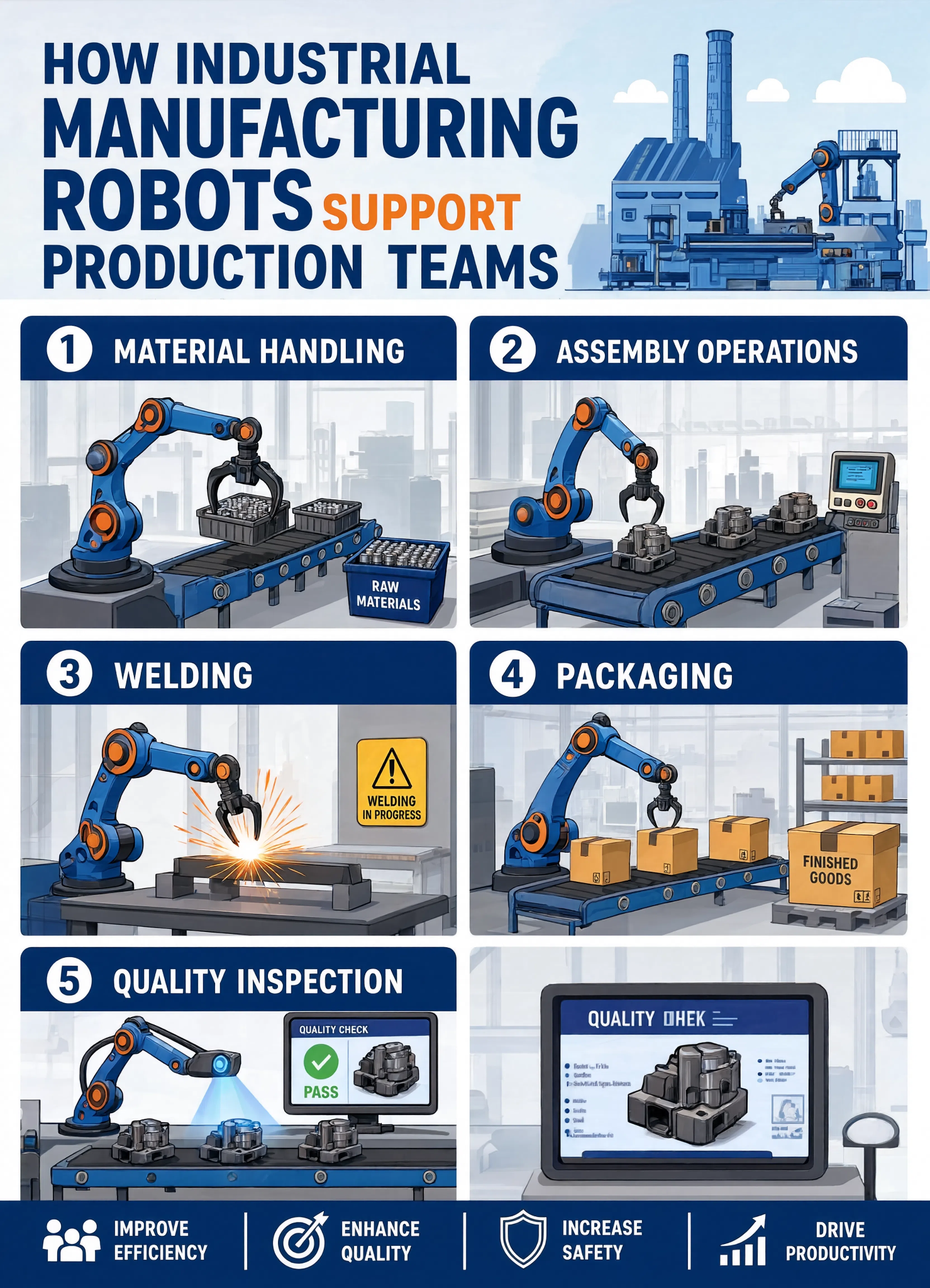
Robots used in industrial manufacturing are designed for the factory floor. The robots fit right into your factory and can take on job tasks that are too repetitive, too precise, or too heavy for your staff. These systems either work seamlessly as independent industrial robots or in conjunction as part of a larger automated cell, which works alongside the production team to ensure output is diverted at the necessary level and consistency of operation.
Applications
- Material Handling
Transporting raw materials between production stages is repetitive, labor-intensive and often a drain on available manpower. These routes, which are handled autonomously by industrial robots, keep the parts moving between workstations at a rate which could not reliably be handled by manual means. - Assembly Operations
Robot automation works best where there can be high volume assembly at faster and precise rates. Every cycle is done to the same standard, limiting variation and keeping the line running smoothly at a steady pace. - Welding
Consistent welds over large production runs, like a robotic welding system. The ability of commercial cleaning robots to maintain consistent heat, speed and position in a way that is practically impossible to achieve manually at scale improves weld quality and cuts down on waste. - Packaging
Robots offer dependable and high-speed performance for sorting, packing, and labelling finished goods at the end of a production line. These systems are adaptable to various product sizes and packaging formats without much reconfiguration. - Quality Inspection
Robotic inspection systems also use sensors and imaging tech to identify defects, dimensional errors and surface irregularities prior to leaving the line. As a result, less defective products reach customers, and the cost of rework and returns also go down.
Benefits
1. Increased Production Output
Robots can work for long shifts without breaks, changeover delays or the variability associated with rotating staff. When the output of production becomes more predictable, capacity is no longer limited by how many people show up to work that day.
2. Improved Accuracy
Robotic installations operate with consistent accuracy and never deviate from their intended programmed parameters over time. Every cycle, tasks that require the same position, force or speed are carried out to the same standard to minimise errors and enhance quality.
3. Reduced Downtime
Production lines experience fewer stoppages when robots take over things that can create bottlenecks, whether it’s due to inconsistent staffing, manual handling errors or inspection gaps. Scheduled upkeep on robotic systems is also more predictable than managing the unpredictability of workforce absences.
4. Better Workplace Safety
Taking workers away from high-risk, high-strain jobs results in decreased injury rates and limited exposure. As factories use industrial robots for welding, heavy material handling and repetitive assembly, they typically experience measurable improvements in safety records along with productivity gains.
Delivery Robots Improve Internal Logistics and Material Movement
The autonomous delivery robot system is designed to move materials, components and inventory throughout the facility environment, without human operators. Autonomous vehicles are capable of travelling warehouse floors, factory floors, and distribution centres. These vehicles, equipped with onboard sensors and mapping technology, follow predetermined routes but also adapt to obstacles and changes in floor conditions in real time. In cases and facilities where internal transportation is a permanent and labour-intensive function, these systems deliver cover not dependent on staffing.
Examples
- Transporting Materials Between Workstations. Movement of components and materials between production stages is an ongoing requirement on any shop floor. Delivery robots operate on these routes so that workers can focus on skilled work, providing each workstation with supplies at the line’s pace.
- Moving Inventory Across Warehouses. A considerable fraction of the warehouse labour hours is spent moving stock between storage, picking and dispatch. Robots carry out this task by themselves so that no staff members need to be assigned. This alleviates physical dirt on staff and ensures the flow of inventory is never tied to staff levels at any one time.
- Supporting Manufacturing Facilities Robots go beyond simple delivery by delivering material to production lines from supply areas, which improves efficiency and asset utilization through intelligent automation. The production runs smoothly and delays caused by a manual transport gap are eliminated when items arrive on time and in the correct order.
Benefits
Faster Movement of Goods: Delivery robots work around the clock without needing a break, shift change or competing demand. The movement of materials through the facility is even, regardless of staffing levels, keeping production lines and picking operations constantly on the go.
Reduced Manual Transport Tasks: The internal transport work is physically taxing and diverts workers from higher-value tasks. Once delivery robots will use these routes staff will no longer be diverted to move materials. Less repetitive strain on the body reduces injury rate and increases retention.
Improved Workflow Efficiency: When material movement is automated and predictable, the overall operation benefits. With better organization, production schedules are easier to maintain, picking accuracy improves, and transport bottlenecks decrease. More and more facilities with lean teams are finding that delivery robots are picking up a meaningful share of the daily workload to help operations get closer to target capacity.
Warehouse Cleaning Robots Help Maintain Safe Facilities
The Importance of Maintaining Large Facilities. Wherever there is human activity or production, operational and safety cleanliness is necessary. Floors that are littered with debris pose a trip and fall hazard, damages equipment and products and brings the business into regulatory risk. To keep the large facility clean by using manual labour is a continuous challenge.
Labour Challenges in Industrial Cleaning. Industrial cleaning roles are among the hardest to staff and retain. The work is physically demanding, often performed during off-peak hours, and carries high turnover. Shift coverage gaps lead to inconsistent cleaning schedules. When cleaning falls behind, safety standards slip, compliance risk grows, and recovery costs compound.
How a Warehouse Cleaning Robot Automates Floor Cleaning A warehouse cleaning robot handles large-area floor cleaning autonomously on programmed routes and schedules, without continuous supervision. These systems map facility layouts, navigate around obstacles, and adjust cleaning patterns based on the environment. They operate during off-peak hours or between shifts, maintaining consistent floor cleanliness without displacing active operations or depending on manual crew availability.
Applications
Warehouses
Warehouse floors accumulate dust, debris, and spills across large surface areas throughout the operational day. Cleaning robots cover these areas systematically on programmed schedules, maintaining floor standards that would require significant manual labour to match consistently.
Distribution Centres
In high-traffic distribution environments where goods move constantly, and floor conditions change throughout the day, cleaning robots provide reliable coverage during off-peak windows. Clean floors in these facilities directly support safe forklift operation, accurate product handling, and regulatory compliance.
Manufacturing Facilities
Manufacturing floors generate dust, metal shavings, fluid residue, and other byproducts that require regular cleaning to maintain safe working conditions. Cleaning robots handle routine floor maintenance in these environments, allowing cleaning staff to focus on equipment sanitation and area-specific tasks that require direct human attention.
Retail Storage Areas
Back-of-house retail storage areas and stockrooms are often deprioritized when cleaning resources are stretched. Cleaning robots maintain these spaces on schedule without requiring dedicated staff to be assigned to them, keeping storage areas clean, organized, and compliant with facility standards.
Cleaning Robots Reduce Dependence on Manual Cleaning Staff
Cleaning robots are machines used to clean floors without requiring constant human control operating at different levels. They design the layout of a facility, implement a programmed cleaning sequence and avoid obstacles. Once you put these robots to work, they stick to their schedules, needing very little supervision. These robots can clean large areas on a frequent basis, which is the most labour-intensive activity carried out in any industrial or commercial establishment.
Benefits
Consistent Cleaning Schedules
Autonomous cleaning robots follow set schedules and complete fixed courses of action. No productivity is compromised due to handovers and absenteeism. Facilities maintain the same standards of cleanliness with every shift, every day.
Reduced Labour Requirements
Floor cleaning of large areas is a very labour intensive activity in facilities management The use of cleaning robots ensures that robots autonomously take care of this, minimizing headcount for achieving basic cleanliness in warehouses, distribution centres, and manufacturing floors.
Improved Hygiene Standards
Robots consistently execute tasks according to set programming and schedule. For operations with regulatory hygiene requirements, this reliability directly supports ongoing compliance regardless of staffing levels.
Data-Driven Cleaning Reports
Modern cleaning robots generate automated reports that document coverage, cycle times, and incomplete routes. This offers a verifiable cleaning record that aids compliance documentation and identifies areas requiring more frequent attention.
Focused Teams, Better Outcomes
When robots assume routine floor tasks, cleaning staff can focus on the work that requires human intelligence like equipment cleaning, chemical handling, restroom servicing, and area-specific work.
Robotics companies in Canada are increasingly focused on solutions that work alongside existing teams rather than replacing them. This approach covers the high-volume functions that drive turnover and create chronic staffing gaps.
Key Benefits of Robotics for Businesses Facing Labour Shortages
- Increased Productivity Robotic systems operate across extended hours and do not require breaks, shift changes, or recovery time. Output becomes more predictable.
- Consistent Operations Robots follow programmed parameters precisely. Quality and output do not vary based on staffing levels or individual performance.
- Enhanced Workplace Safety: Automating physically demanding or hazardous tasks reduces injury rates and limits workers’ exposure to high-risk conditions.
- Lower Long-Term Labour Costs The upfront investment in automation is offset over time by reduced recruitment, training, and turnover costs.
- Improved Employee Satisfaction Workers assigned to more meaningful, skilled tasks tend to report higher job satisfaction and are more likely to remain with the organization.
- Better Scalability During Growth. Robotic systems can be scaled to meet increased demand without the delays associated with hiring and onboarding new staff.
Choosing the Right Robotics Partner in Canada
Implementing automation involves more than picking the right equipment. Companies require a partner that has expertise in their industry and the ability to incorporate robotics with their operations.
Key factors to evaluate include:
- Industry expertise: Experience working with facilities and workflows similar to your own
- Integration support: Ability to connect robotic systems with existing equipment, software, and processes
- Training and maintenance: Ongoing support to ensure systems remain operational and staff are equipped to work alongside them
- Scalability: Solutions that can grow as operational needs change
- ROI analysis: Clear projections on cost recovery and long-term value
Robotics integration services from established providers in Canada ensure deployment is structured, supported, and aligned with business objectives rather than being treated as merely an equipment purchase.
Future-Proofing Your Business with Robotics
What separates leading robotics companies in Canada is an understanding that automation performs best when it is built around how a workforce actually operates, not just around what a machine is capable of doing.
- Labour Shortages Are Expected to Continue Canada’s labour shortages are not a temporary condition. They reflect an aging workforce, a fertility rate declining since 2009, and a retirement wave that will intensify through the end of the decade. Businesses waiting for conditions to normalize are working against the demographic data.
- Automation Helps Businesses Remain Competitive Unfilled shifts have real consequences: production shortfalls, missed deadlines, and declining facility standards. Businesses that have automated vulnerable functions are not carrying that exposure. Those still dependent on traditional staffing models fall further behind with each hiring cycle that comes up short.
- Robotics Complements Human Workers Robotic automation covers high-volume, physically demanding roles that drive turnover and create chronic vacancies. When those positions are stabilized, existing staff focus on work requiring judgment, technical skill, and problem-solving, where retention is stronger and contribution is higher.
- Long-Term Operational Resilience A business built around persistently hard-to-fill roles will keep losing ground to competitors that have removed that dependency. Automation stabilizes capacity, makes costs more forecastable, and reduces reliance on hiring conditions outside the business’s control.
Conclusion
Labour shortages across Canada are reshaping how businesses operate. For manufacturers, warehouse operators, logistics providers, and facility managers, the gap between staffing capacity and operational demand continues to grow.
Robotics provides a grounded, scalable response. Industrial manufacturing robots keep production lines moving. Delivery robots streamline internal logistics. Warehouse cleaning robots and broader cleaning robot systems maintain facility standards without relying on hard-to-retain manual crews. Across all of these applications, the goal is the same: keep operations running at the level the business requires.
Robotools Canada works with businesses to identify where robotic automation creates the most value and to implement solutions that integrate with existing teams and workflows. If your business is navigating staffing pressure, exploring your options with an experienced robotics partner is a practical next step.
Faq
What industries benefit most from industrial manufacturing robots?
Automotive, food processing, electronics, metal fabrication, and consumer goods manufacturing are among the most active adopters. Any production environment with high-volume, repetitive tasks is a strong candidate for industrial robot deployment.
Are delivery robots suitable for warehouses and manufacturing facilities?
Yes. Delivery robots are designed specifically for indoor industrial environments. They handle material transport between workstations and across warehouse floors, reducing the manual handling burden on staff and improving workflow continuity.
What are the benefits of a warehouse cleaning robot?
These systems automate large-area floor cleaning on consistent schedules, operate without supervision during off-peak hours, and reduce the staffing requirements for routine facility maintenance. They also generate automated cleaning reports that support compliance and facility management documentation.
Do cleaning robots replace employees?
Not entirely. Cleaning robots handle high-frequency, large-area tasks that consume most of the labour hours in facility cleaning. Staff are then available for detailed work, equipment sanitation, and specialized cleaning that requires direct human involvement.
How do robotics companies in Canada support automation projects?
Established Canadian providers offer end-to-end support that includes needs assessment, system integration, staff training, and ongoing maintenance. This structured approach ensures that automation delivers measurable results and fits within existing operational frameworks.